

Cloth-Based Packaging for Spiritual Products Market Forecast 2036: Market to Reach USD 1,860 Mn by 2036 at 13.6% CAGR
Cloth-Based Packaging for Spiritual Products Market
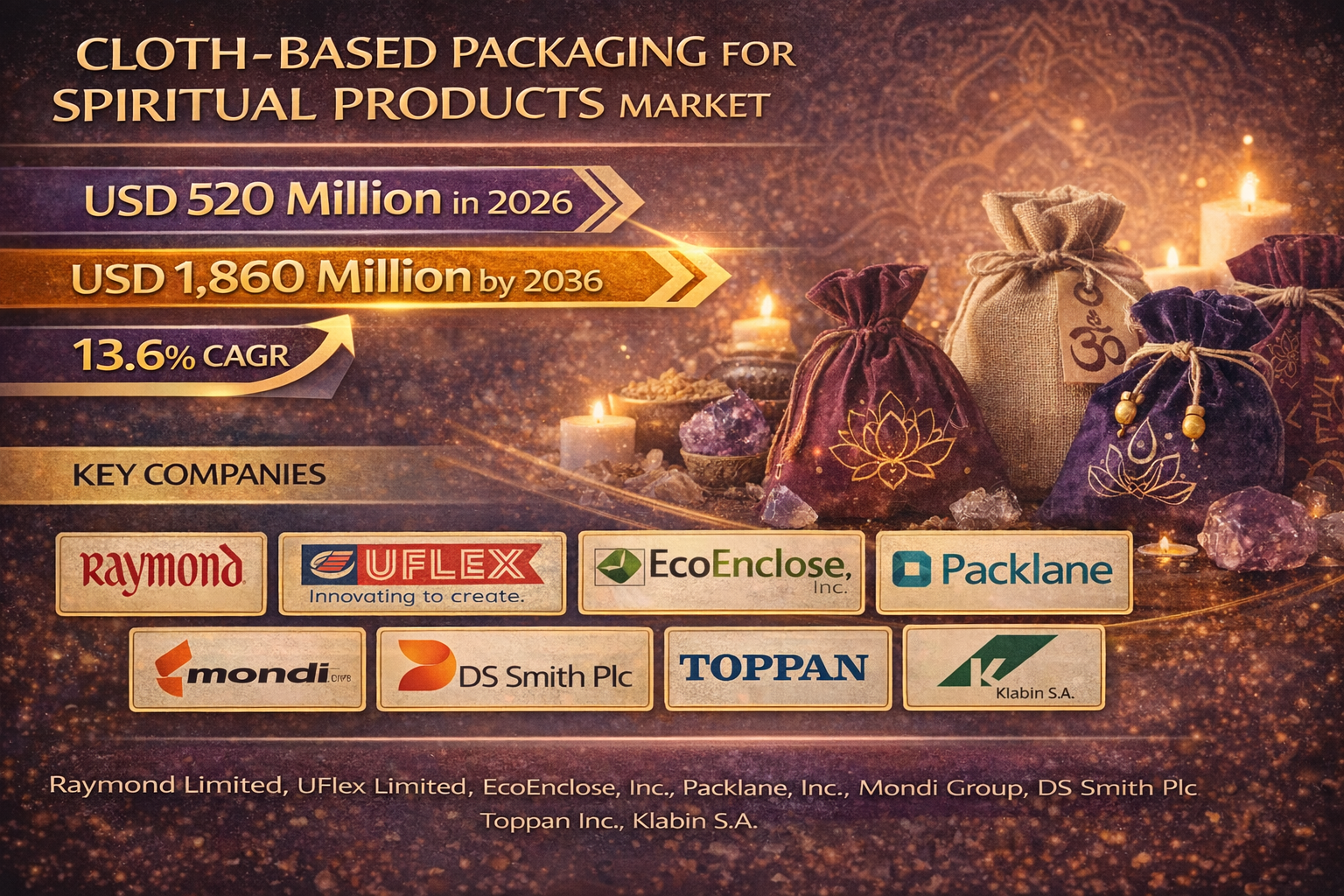
The cloth-based packaging for spiritual products market is forecasted to total USD 520 mn in 2026, and is expected to increase further to USD 1,860 mn by 2036.
NEW YORK, DE, UNITED STATES, February 18, 2026 /EINPresswire.com/ -- The Cloth-based Packaging for Spiritual Products Market is projected to expand from USD 520 million in 2026 to USD 1,860 million by 2036, advancing at a CAGR of 13.6% over the forecast period. The surge reflects a structural shift from voluntary sustainability adoption to mandatory compliance-driven packaging usage across temples, spiritual retail networks, and export channels. Regulatory mandates, institutional bans on single-use plastics, and textile infrastructure modernization are accelerating the transition toward reusable, biodegradable cloth-based packaging formats.
• Market size in 2026 USD 520 million
• Market size in 2036 USD 1,860 million
• CAGR (2026–2036) 13.6%
• Leading end-use segment Temple & Ashram Sales (48% share in 2026)
• Leading material type Cotton Fabric (46% share in early 2026)
• Leading packaging format Drawstring Pouches (42% share in 2026)
• Fastest-growing country India (16.40% CAGR through 2036)
• Top companies: Raymond Limited, UFlex Limited, EcoEnclose, Inc., Packlane, Inc., Mondi Group, DS Smith Plc, Toppan Inc., Klabin S.A.
Market Momentum (YoY Path)
The Cloth-based Packaging for Spiritual Products Market demonstrates strong forward momentum. The market stands at USD 520 million in 2026 and progresses steadily as institutional mandates take effect. By 2028, early regulatory enforcement across pilgrimage sites strengthens adoption. In 2030, textile infrastructure expansion under programs such as the National Fibre Scheme supports supply scalability. By 2031, export-driven compliance with the EU Packaging and Packaging Waste Regulation (PPWR) reinforces durable cloth adoption. In 2033, modernization of textile clusters and circular economy integration accelerate commercial-grade production. Ultimately, the market reaches USD 1,860 million by 2036, reflecting a decade of compliance-led and premiumization-driven growth.
Why the Market is Growing
Growth of the Cloth-based Packaging for Spiritual Products Market is primarily driven by regulatory enforcement and institutional mandates. Temple authorities and religious trusts are replacing thin plastic films and polythene packaging with cloth bags and natural fibers. Government fiscal support, including the National Fibre Scheme and Tex-Eco Initiative, is reducing cost barriers for sustainable textile packaging production.
Internationally, the EU Packaging and Packaging Waste Regulation (effective August 12, 2026) mandates recyclable and reusable packaging, directly impacting spiritual goods exports. Domestically, significant allocations for urban waste management and intensified enforcement of single-use plastic bans are accelerating baseline adoption of cloth-based alternatives. The shift is no longer discretionary it is operationally required.
Request For Sample Report | Customize Report | Purchase Full Report - https://www.futuremarketinsights.com/reports/sample/rep-gb-32073
Segment Spotlight
1) End Use – Temple & Ashram Sales Lead (48%): Temple & Ashram Sales represent the largest segment with a 48% share in 2026. Institutional bans on non-biodegradable materials across pilgrimage hubs are driving this dominance. Large religious bodies have mandated cloth-based packaging for prasadam, puja offerings, and devotional artifacts. International adoption—from Bhaktivedanta Manor in the UK to shrine associations in Japan reinforces cloth packaging as the global institutional standard.
2) Material – Cotton Fabric Leads (46%): Cotton fabric commands 46% share due to its biodegradability, washability, and global supply chain expansion. Organic textile initiatives and packaging recyclability mandates favor cotton over synthetic blends. Digital textile printing and reinforced cotton fabrics for e-commerce shipments further strengthen its utility across export and domestic markets.
3) Packaging Format – Drawstring Pouches Dominate (42%): Drawstring pouches account for 42% of demand in 2026. Their repurposable nature extends packaging lifecycle indefinitely. EU labeling harmonization under PPWR favors natural closures over plastic zippers, supporting drawstring adoption. Innovation includes NFC-integrated pouches and luxury velvet or linen formats for premium spiritual merchandise.
Drivers, Opportunities, Trends, Challenges
• Drivers: Mandatory compliance frameworks, including the EU PPWR and domestic plastic bans, are transforming cloth packaging into a legal requirement. Government-backed textile infrastructure modernization ensures consistent material supply and reduces production barriers for MSMEs.
• Opportunities: Public investment in natural fiber supply chains and modernization of textile clusters is lowering production costs for artisanal formats such as block-printed pouches. Institutional procurement mandates provide predictable demand across pilgrimage hubs and export markets.
• Trends: The market is witnessing high-tech circularity through upcycled religious cloth offerings processed via AI-driven robotics and near-infrared spectroscopy. Digital traceability, NFC tagging, and ethical sourcing verification are integrating traditional textiles with connected packaging ecosystems.
• Challenges: Raw material availability presents structural constraints. Global cotton production for 2025/26 is projected to decline to 119.4 million bales. Capital-intensive modernization of weaving equipment remains a barrier for smaller textile units, despite temporary regulatory relief measures.
Competitive Landscape
The Cloth-based Packaging for Spiritual Products Market is transitioning from artisanal supply chains to industrialized textile platforms. Competitive differentiation centers on sustainable fiber access, industrialized finishing, digital traceability, and scalable artisanal aesthetics.
Key companies include:
• Raymond Limited
• UFlex Limited
• EcoEnclose, Inc.
• Packlane, Inc.
• Mondi Group
• DS Smith Plc
• Toppan Inc.
• Klabin S.A.
Why FMI: https://www.futuremarketinsights.com/why-fmi
Have a Look at Related Research Reports on the Packaging Domain:
Toilet Roll Converting Lines Market: https://www.futuremarketinsights.com/reports/toilet-roll-converting-lines-market
Refill-System-Compatible PCR Packaging Market: https://www.futuremarketinsights.com/reports/refill-system-compatible-pcr-packaging-market
Design-for-Recycling Packaging Market: https://www.futuremarketinsights.com/reports/design-for-recycling-packaging-market
About Future Market Insights (FMI)
Future Market Insights, Inc. (FMI) is an ESOMAR-certified, ISO 9001:2015 market research and consulting organization, trusted by Fortune 500 clients and global enterprises. With operations in the U.S., UK, India, and Dubai, FMI provides data-backed insights and strategic intelligence across 30+ industries and 1200 markets worldwide.
Sudip Saha
Future Market Insights Inc.
+1 347-918-3531
email us here
Legal Disclaimer:
EIN Presswire provides this news content "as is" without warranty of any kind. We do not accept any responsibility or liability for the accuracy, content, images, videos, licenses, completeness, legality, or reliability of the information contained in this article. If you have any complaints or copyright issues related to this article, kindly contact the author above.
